

In 1966 Stanley Mouse and Alton Kelley, two San Francisco artists, were asked to make a poster for a Grateful Dead show at the Avalon Ballroom. In the San Francisco Public Library they found a 1913 edition of the Rubaiyat of Omar Khayyam illustrated by Edmund J. Sullivan, and in it a drawing of a skeleton surrounded by roses, with a crown of roses on its head. The book couldn't be checked out, so Kelley cut the page out with a pen knife and took it to their studio, Mouse told Rolling Stone in 2022. Given how old the drawing was, he said, "It seemed pretty copyright-free."
Other famous band images started the same way. The Misfits took their skull from the villain of The Crimson Ghost, a 1946 Republic film serial, and the lettering of their third logo from Famous Monsters magazine. The horned skull on Initium, a 1984 record by Glenn Danzig's band Samhain, closely matches one on the cover of Crystar #8, a Marvel comic from the same year, and Danzig later registered it as a trademark in his own name. The Ramones' art director redrew the presidential seal with a baseball bat where its arrows had been, and Joy Division's Unknown Pleasures cover came out of a 1970 doctoral thesis on pulsars.
The Grateful Dead's skull and roses
Mouse colored the copy and added the lettering. The poster advertised the Grateful Dead at the Avalon on September 16 and 17, 1966, and the Denver Art Museum's record of it credits Kelley and Mouse.
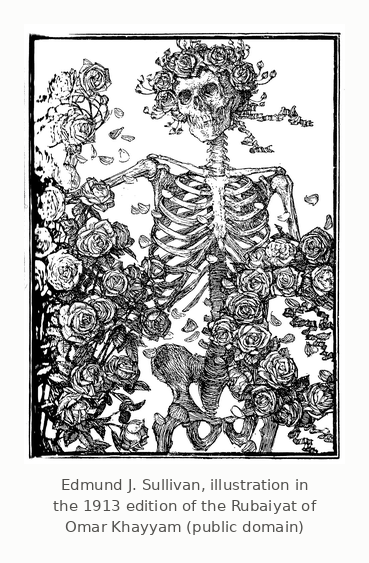
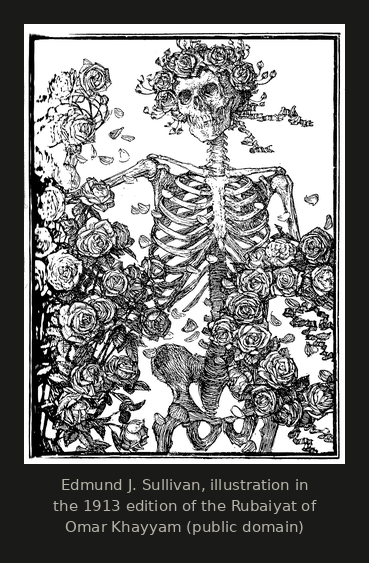 Sullivan's skeleton among roses, from the 1913 edition of the Rubaiyat. Public domain.
"A few years ago, at a talk at the library, I fessed up to it," Mouse said in 2022. "They laughed it off. I imagine Sullivan is chuckling in his grave."
Sullivan's original drawing, dated 1900, came up at Christie's in New York around 1993, and the collector Jacaeber Kastor bought it for $11,000. The other bidders, Kastor told the magazine, were "stone-cold Victorian illustration guys." He added, "Nobody there understood the reference." Mouse, at 81, said: "I'm most famous for something I didn't do."
Danzig's horned skull
Michael Golden's cover for The Saga of Crystar, Crystal Warrior #8, a Marvel comic dated July 1984, has a large green horned skull with fangs across its lower half. Golden signed it "MG." The issue was on newsstands on April 3, 1984, according to the trade magazine Amazing Heroes, as indexed by Ausreprints. That August, Samhain, Glenn Danzig's band after the Misfits, released Initium, with a black-and-white horned skull above the band's name.
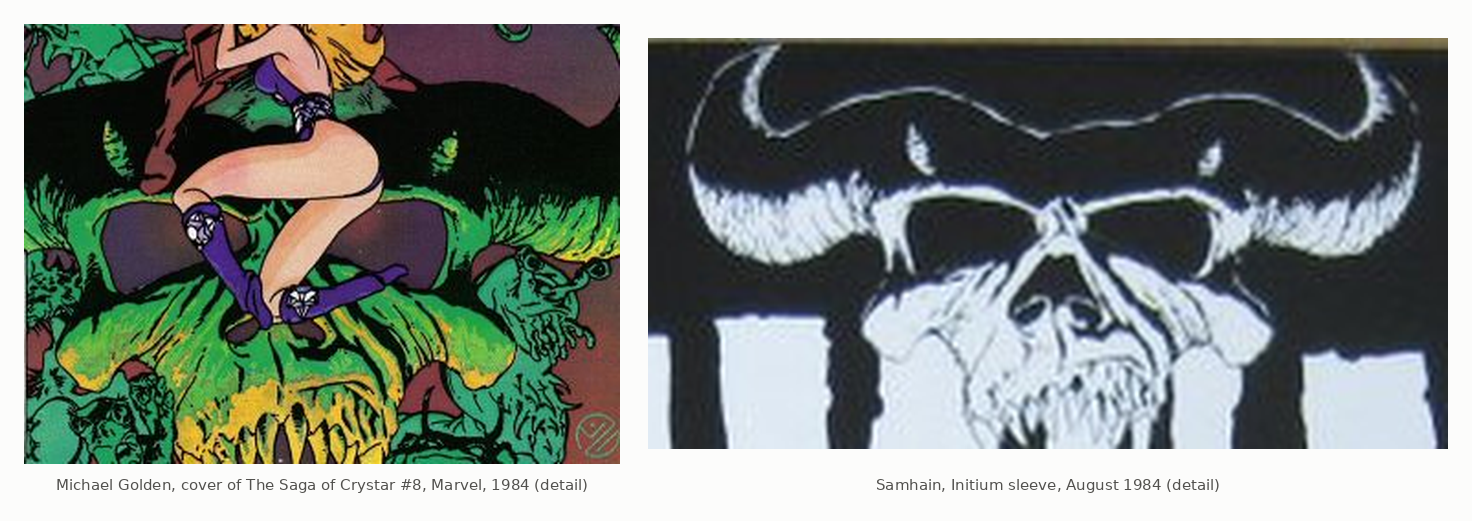
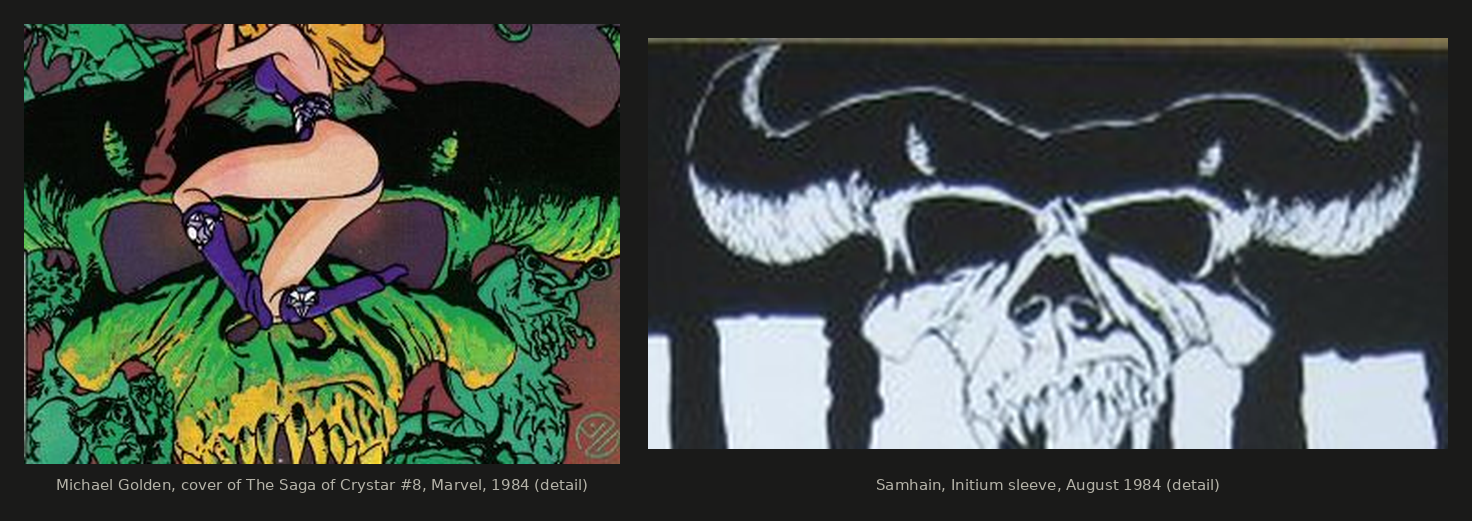 The Crystar #8 cover, on sale April 1984, and the Initium sleeve, August 1984.
On April 25, 1985, Samhain played an all-ages show at the Electric Banana in Pittsburgh. Spahr Schmitt, who was 15, wrote in 2010 that he met Danzig that night, talked comics with him and told him he knew the logo came from the cover of Crystar #8. By Schmitt's account, Danzig replied, "Uhhh … I had to finish it!"
Danzig owns two U.S. trademark registrations for horned skulls. The first, issued in 2006, covers "a stylized skull design featuring sharp teeth and large horns." The second, issued in 2011, covers a horned skull with sunglasses and "long pointed fanglike teeth."
| Date | Record |
|---|---|
| March 1983 | First use of the horned skull, as claimed by Danzig in his 2004 trademark application |
| 1983 | First use of the horned skull with sunglasses, as claimed in his 2010 application |
| April 3, 1984 | Crystar #8, cover dated July 1984, on newsstands, per Amazing Heroes as indexed by Ausreprints |
| August 1984 | Samhain's Initium released with a horned skull on its cover |
| September 19, 2004 | Danzig files his first trademark application |
| April 18, 2006 | First registration issued |
| November 19, 2010 | Second application filed |
| August 9, 2011 | Second registration issued |
| June 24, 2026 | First registration renewed for the second time |
The Ramones' seal
Arturo Vega, the Ramones' art director, said in a 2008 interview with Thirsty that he had been working with eagles since photographing a 1972 Eisenhower dollar in 1973, and that "on the trip to Washington in 1976 I saw the presidential seal and I went, 'ok, this is it!'" He kept the seal's olive branch. The baseball bat "was kept as in the spirit of the arrows," he said, but "it was also a tribute to Johnny's baseball fanaticism."
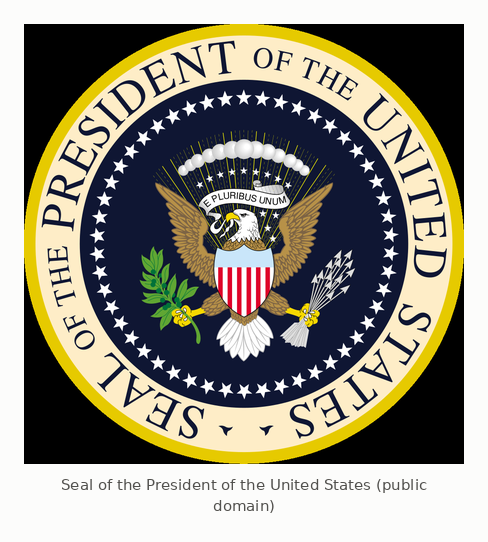
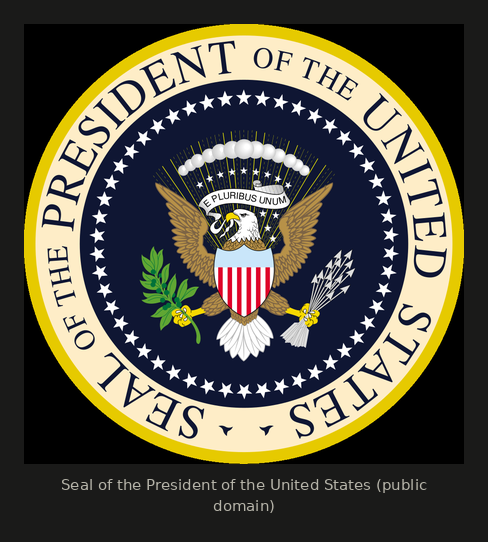 The seal Arturo Vega adapted for the Ramones. Public domain.
Joy Division's pulsar
Harold D. Craft Jr. was a Cornell graduate student at the Arecibo radio observatory when pulsars were discovered. For his thesis, dated September 1970, he stacked 80 successive pulses from CP1919, the first pulsar discovered, into one computer-drawn plot. Scientific American printed a version of it as a full page in January 1971. Peter Saville put a white-on-black version on Joy Division's Unknown Pleasures in 1979, with no band name or album title. Saville has said the cover came from a figure in the 1977 Cambridge Encyclopaedia of Astronomy, and in 2015 Jen Christiansen of Scientific American followed that figure back to Craft's thesis.
"It was a complete surprise," Craft told Christiansen in February 2015. A colleague, Jim Cordes, saw him on the street and asked whether he knew "your image is on the cover of Joy Division." Craft went to a record store and bought the album and a poster, "just for no particular reason, except that it's my image, and I ought to have a copy of it."
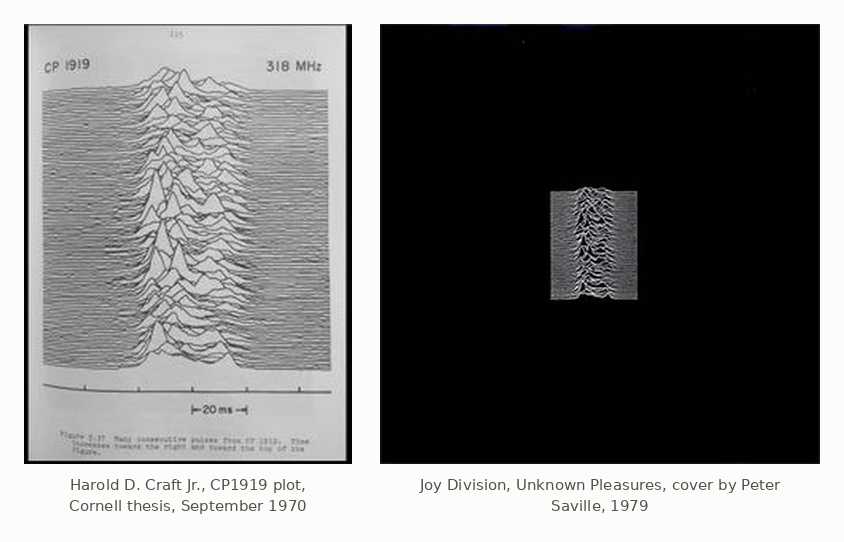
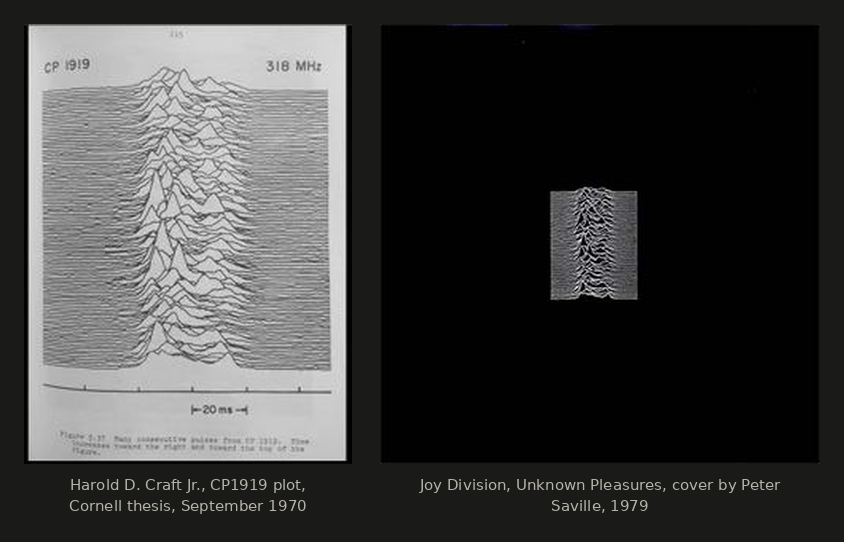 Craft's thesis plot of CP1919, 1970, and the Unknown Pleasures cover, 1979.
In January 2012 the Disney Store sold a "Waves Mickey Mouse tee" that referenced the cover. Peter Hook, Joy Division's bassist, called it a backhanded compliment and told Billboard he had tried to buy one. "It is in the public domain, but it's Peter Saville's idea and it's Joy Division's association that makes it popular," he said.
Venom's sigil
Conrad Lant, known as Cronos, brought a copyright case in England over Venom's artwork. In the judgment of July 31, 2025, he accepted that the band's Sigil of Baphomet "was an adaptation of an 1897 design by the occultist Stanislas de Guaita." Anthony Bray, known as Abaddon, whom the same judgment found to have drawn the band's first logo, said another of Lant's designs, "Goat Head Lucifer," was "based closely upon a painting by Austin Osman Spare." Neither side argued that the sigil lacked the originality copyright requires, and the court upheld Lant's copyright in both designs.
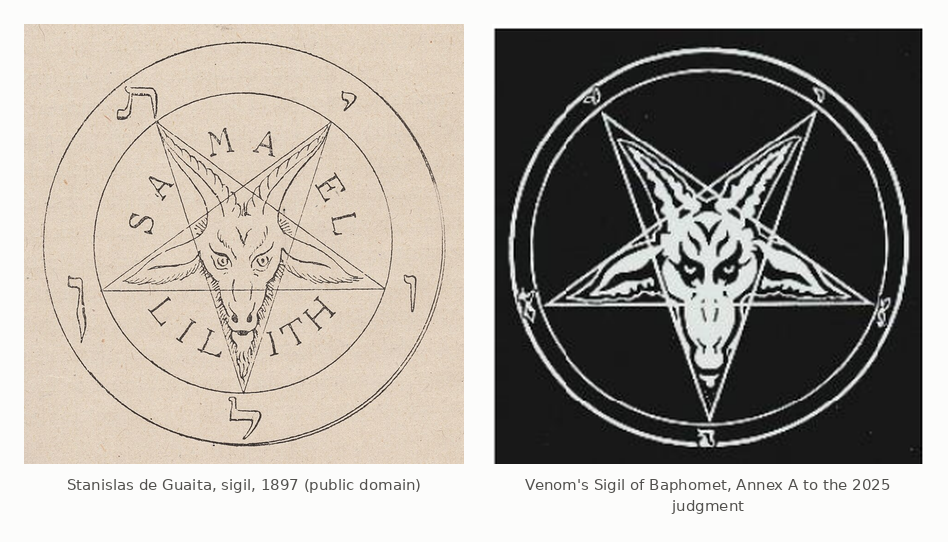
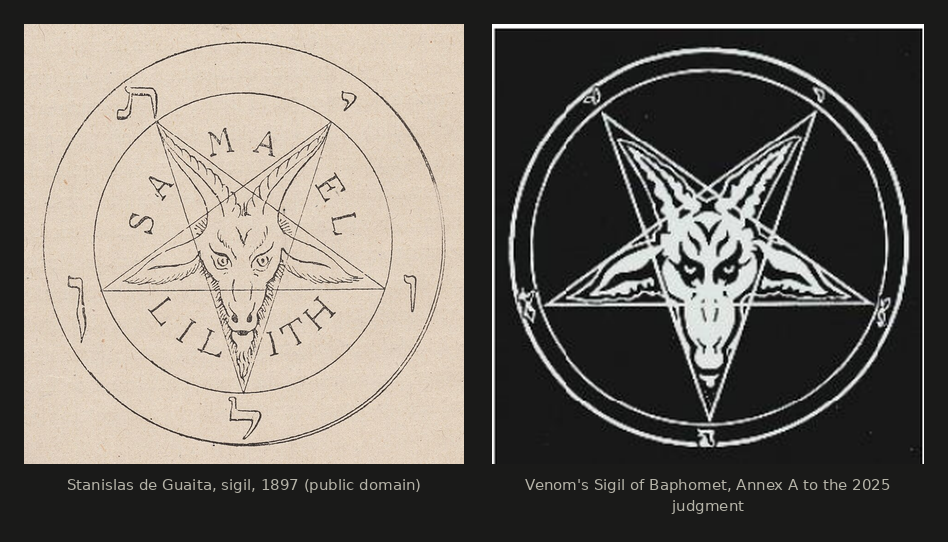 Guaita's 1897 sigil and Venom's version, as annexed to the 2025 judgment.
Crystal Castles' Madonna
Crystal Castles, a Canadian duo, began using Trevor Brown's "bruised Madonna" after seeing it on a flyer in 2006 and sold it on T-shirts on tour, NME reported in September 2008. Brown accused them of not paying him royalties or properly crediting him. By September 2008 the band's management had paid him for its use and bought the rights to the image. "Crystal Castles have redeemed themselves – I've been paid off!" Brown wrote on his blog. The band told NME: "It took us a while to build up our collection of pennies but we finally saved enough money to pay the man who drew the image which we have taken as our logo."
Nirvana's smiley face
On December 28, 2018, Nirvana L.L.C. sued Marc Jacobs over its "Bootleg Redux Grunge" clothing, saying in its complaint that the smiley was "created by Kurt Cobain in about 1991 and registered for copyright in 1993." It said the Marc Jacobs clothing used "a design and logo virtually identical to Nirvana's copyrighted image." Robert Fisher, a former designer at Geffen Records, then said he had drawn it and claimed to own it.
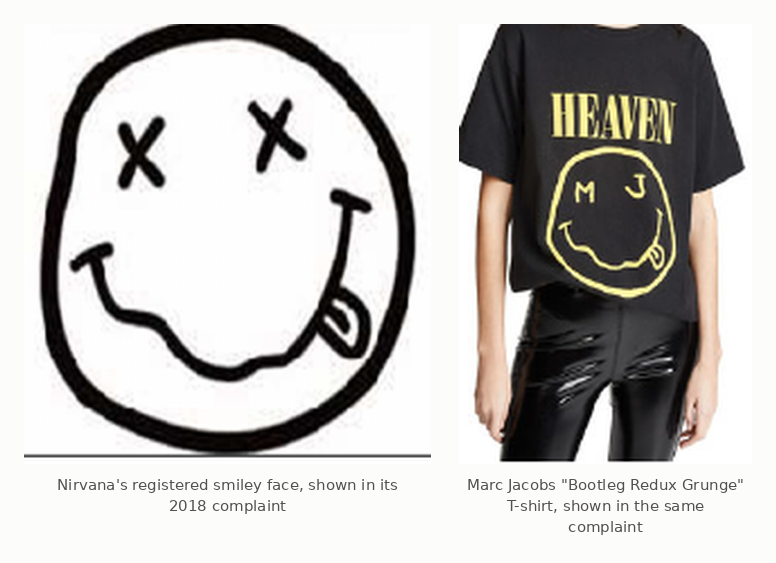
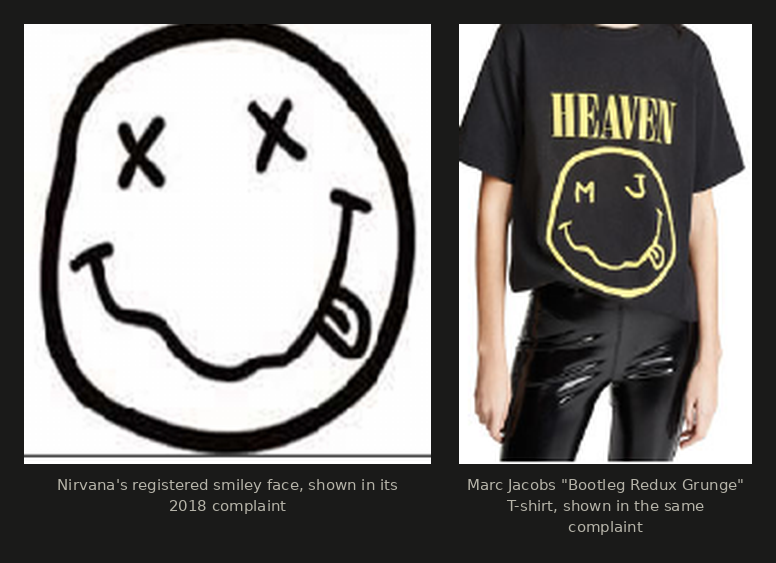 Both images as they appear in Nirvana's 2018 complaint against Marc Jacobs.
In December 2023 the judge ruled "that, assuming Fisher drew the Smiley, it was a work for hire for Geffen and, assuming Cobain drew the Smiley, Nirvana owns the rights to the Smiley." Fisher appealed. Nirvana and Marc Jacobs settled in 2024, and Judge John A. Kronstadt dismissed "all claims and counterclaims" with prejudice.
The Misfits' Crimson Ghost skull
The Misfits' skull is the face of the villain in The Crimson Ghost, a 12-chapter serial whose copyrights Republic Pictures registered in August and September 1946, according to the Catalog of Copyright Entries. Interviewing Danzig in 2009, the Austin Chronicle described the band's mascot as a Republic Pictures villain he "plucked from serial oblivion." In the same interview Danzig said, "Growing up, every kid who was into horror was into Famous Monsters magazine. And then, of course, I ended up using that classic Famous Monsters [font] for the third Misfits logo."
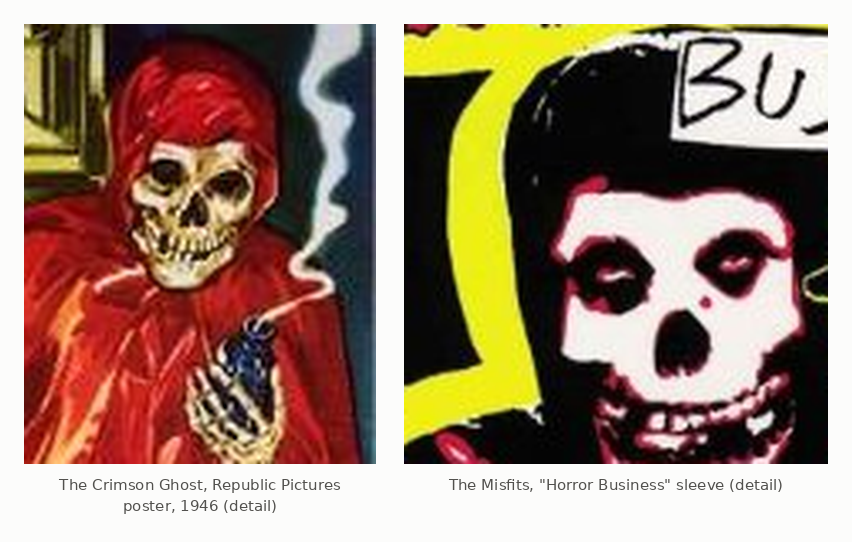
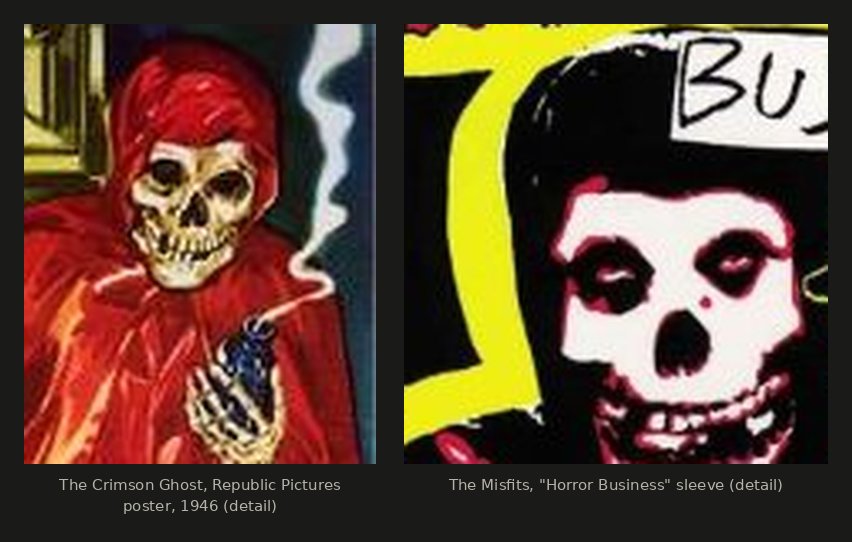 The Crimson Ghost on Republic's 1946 poster, and the Misfits' skull on the Horror Business sleeve.
The Misfits broke up in 1983. According to Danzig's later allegations, Jerry Only, the bassist, and other former members sued him in 1992, claiming the exclusive right to the band's name, logos and artwork. The 1994 settlement that ended that suit made the two "co-owners of the name and trademarks of the Misfits and all logo(s) and artwork," each with a non-exclusive right to sell merchandise.
In October 2003 Cyclopian Music registered the skull, known as the Fiend Skull, as a trademark, claiming first use on October 1, 1978. Danzig asked the Trademark Trial and Appeal Board to cancel the registration in 2008, then sued Only and Cyclopian in 2014. As the judge summarized his allegations, Danzig had been "responsible for creating The Misfits' widely popular logo, a skeletal pattern known as the 'Fiend Skull,'" and the defendants had falsely claimed exclusive ownership by registering trademarks. Judge R. Gary Klausner ruled for Only and Cyclopian in April 2015: under the 1994 settlement they did own and control the Misfits trademarks, though not exclusively. The trademark board dismissed Danzig's petition in December 2017.
Danzig and Only reunited as the Original Misfits in 2016, and on October 19, 2019, they headlined a sold-out show at Madison Square Garden. The two had formed a company, Misfits A.D., to manage the band's intellectual property, and it owned the Fiend Skull registration. In March 2020 it sued Harry N. Abrams, the publisher of a Misfits photobook called Scream With Me, over the book's use of the skull and the band's artwork. Misfits A.D. withdrew the case, with prejudice, on July 21, 2020, before Abrams had answered. The complaint had described the Misfits' artwork as "original elements that are indelibly linked with the band including, for example, the Misfits 'Horror Font' and Fiend Skull logos."
Image Credits
- Skeleton among roses, illustration for the Rubaiyat of Omar Khayyam (1913 edition), Edmund J. Sullivan. Public domain. Wikimedia Commons, File:Edmund J Sullivan Illustrations to The Rubaiyat of Omar Khayyam First Version Quatrain-026.jpg.
- Seal of the President of the United States, U.S. government. Public domain. Wikimedia Commons, File:Seal of the President of the United States.svg.
- CP1919 plot, Harold D. Craft Jr., Cornell University doctoral thesis, September 1970, as photographed for Scientific American by Jen Christiansen (2015). Used for comparison.
- Unknown Pleasures cover, Peter Saville for Factory Records, 1979. Used for comparison. Source: Wikipedia, File:UnknownPleasuresVinyl.jpg.
- Sigil of Baphomet, Stanislas de Guaita, 1897. Public domain. Wikimedia Commons, File:Sigil of Baphomet.jpg.
- Venom's Sigil of Baphomet, copyright Conrad Lant per the 2025 judgment, from Annex A of Lant v Plastic Head Music Distribution Ltd [2025] EWHC 1954 (IPEC), The National Archives, Find Case Law. Used for comparison.
- Nirvana smiley face (Nirvana, L.L.C.) and Marc Jacobs "Bootleg Redux Grunge" T-shirt (Marc Jacobs International), from the complaint in Nirvana, L.L.C. v. Marc Jacobs International, December 28, 2018, via CourtListener. Used for comparison.
- Cover of The Saga of Crystar, Crystal Warrior #8, Michael Golden, Marvel Comics, 1984 (detail). Used for comparison. Source: Grand Comics Database cover scan via the Wayback Machine.
- Samhain, Initium sleeve, Plan 9 Records, 1984 (detail). Used for comparison. Source: Discogs, release 2050881.
- The Crimson Ghost one-sheet poster, Republic Pictures, 1946 (detail). Used for comparison. Source: Wikipedia, File:The Crimson Ghost poster.jpg.
- The Misfits, "Horror Business" single sleeve, Plan 9 Records, 1979 (detail). Used for comparison. Source: Wikipedia, File:Misfits - Horror Business cover.jpg.
Sources(24)Show allHide
- Library of Congress Copyright Office, Catalog of Copyright Entries (via 16mm Filmography), "The Crimson Ghost," registrations of August 2 and September 2, 1946.
- Denver Art Museum, "Skull and Roses/Grateful Dead, Oxford Circle, Avalon Ballroom, San Francisco," poster by Alton Kelley and Stanley Mouse, 1966, collection record.
- Ausreprints, "The Saga of Crystar, Crystal Warrior #8," index entry citing Amazing Heroes #43, issue dated July 1984.
- Grand Comics Database (via the Wayback Machine), "The Saga of Crystar, Crystal Warrior #8," cover credits.
- Discogs, Samhain, "Initium," Plan 9 PL9-04, release record, August 1984.
- U.S. Patent and Trademark Office, Registration No. 2,770,984, filed April 29, 2002, status record.
- U.S. Patent and Trademark Office, Registration No. 3,081,865, filed September 19, 2004, status record.
- Thirsty, Sarah L. Myers, "Interview with Arturo Vega," May 2008.
- NME, "Crystal Castles' 'Madonna' T-shirt logo dispute over," September 22, 2008.
- Trademark Trial and Appeal Board, Cancellation No. 92050014, Glenn Danzig v. Cyclopian Music, Inc., filed October 6, 2008.
- The Austin Chronicle, Marc Savlov, interview with Glenn Danzig, November 6, 2009.
- Comics Comics, Frank Santoro and Spahr Schmitt, "Esoteric Comics History part 666," April 24, 2010.
- U.S. Patent and Trademark Office, Registration No. 4,008,872, filed November 19, 2010, status record.
- Billboard, Richard Smirke, "Peter Hook Calls Disney's Controversial Joy Division-Inspired T-Shirt a 'Backhanded Compliment'," January 24, 2012.
- Scientific American, Jen Christiansen, "Pop Culture Pulsar: Origin Story of Joy Division's Unknown Pleasures Album Cover," February 2015.
- U.S. District Court, Central District of California, Danzig v. Caiafa, No. CV 14-02540, order granting summary judgment, April 15, 2015.
- U.S. District Court, Central District of California, Nirvana, L.L.C. v. Marc Jacobs International, No. 2:18-cv-10743, complaint, December 28, 2018.
- U.S. District Court, Southern District of New York, Misfits A.D., LLC v. Harry N. Abrams, Inc., No. 1:20-cv-02093, complaint, March 9, 2020.
- U.S. District Court, Southern District of New York, Misfits A.D., LLC v. Harry N. Abrams, Inc., notice of voluntary dismissal, July 21, 2020.
- Scientific American, Jen Christiansen and Harold D. Craft Jr., "Pulsar as Pop Icon," September 2020.
- Rolling Stone, David Browne, "See the Original Art That Inspired the Grateful Dead's Classic Logo," March 4, 2022.
- Billboard, "Nirvana Smiley Face Logo Legal Battle Drags On: Who Created It?," February 1, 2024.
- Digital Music News, Dylan Smith, "Nirvana and Marc Jacobs Officially Resolve Years-Old Lawsuit Over Famed 'Smiley Face' Design," October 9, 2024.
- The National Archives (Find Case Law), Lant v Plastic Head Music Distribution Ltd & Ors [2025] EWHC 1954 (IPEC), judgment of July 31, 2025.