

At 5:45 a.m. on May 2, 1992, David Katz was first in line at the Wherehouse store on College and El Cajon Boulevard. He had got up at 5 hoping for prime seats, and for the next two hours he was the only person in line at that store, the Los Angeles Times reported on May 13, 1992. At 9:30, a Wherehouse employee came out and told the line that the first ticket buyer would be wristband number 42. That made Katz, the first to arrive, the last in line to buy. Soon after, the employee announced that Ticketmaster's mainframe computer in Los Angeles was temporarily out of commission. The start of sales moved from 10 a.m. to 10:30, and then to 11:08. "After five hours of waiting, and paying $27 a pop, I'm sitting at the very back of the arena," Katz told the Times.
Katz's morning ran on rules that Southern California concert buyers met at record stores through the 1990s: a numbered wristband, given out at random before the doors opened, set the order of sale. The Wherehouse chain had joined that system in April 1991, when Ticketmaster added its stores as outlets. The chain was still on Ticketmaster's outlet list in 2009. Its last store closed in 2014.
Music Plus and Ticketmaster, 1985 to 1988
At the start of 1985, Ticketmaster had 105 outlets in Los Angeles, Orange and San Diego counties and in Las Vegas. Its rival Ticketron had 90 in the Los Angeles area, the Times reported on January 31, 1985.
Three Times listings from 1988 sent Ticketmaster buyers to Music Plus record stores. Before an April sale for Bruce Springsteen, eight Southern California radio stations were told at 3:30 on a Friday afternoon that priority wristbands would be given out at Music Plus/Ticketmaster stores from 4 p.m. that day. A June listing said sales would begin at 8 a.m. "at all Music Plus Ticketmaster outlets" and by phone. For a third George Michael show at Irvine Meadows that September, wristbands went out at Music Plus stores at 8 on a Sunday morning, an hour before the sale.
La Cienega Boulevard, March 1990
One line outside a Wherehouse in these years was for autographs. On Tuesday, March 20, 1990, Depeche Mode were due to sign copies of their new album, Violator, from 9 p.m. to midnight at the Wherehouse across the street from the Beverly Center, at La Cienega Boulevard and 3rd Street. The store put on the event with KROQ-FM and the band's label, Jim "Poorman" Trenton, then a KROQ DJ, wrote in a 2019 OC Weekly column. The Times reported the next day that more than 2,000 fans, some of whom had camped out in front of the store since Sunday morning, began shoving to get closer to the band, and that about 100 police officers in riot gear were sent. SPIN's cover story that July put the crowd at "some 20,000." Trenton wrote that when he asked Dave Gahan inside the store whether he had heard the police estimate, Gahan answered, "Yeah, 17,000."
Mike LaJoie got there between 10 and 11 that morning and guessed there were already "200+ people in line." He described the wait to the blog Almost Predictable. Almost in 2020: "Back in those days when concert tickets went on sale we were allowed to camp out. It felt much like that."
San Diego County, April 1991
"TicketMaster is living up to its name by adding the Wherehouse chain to its roster of outlets," John D'Agostino wrote in the Times's calendar notes on April 10, 1991. Seven Wherehouse stores, in Escondido, Oceanside, San Marcos, La Mesa, Imperial Beach, Carlsbad and the College Area, had become fully functioning Ticketmaster locations that Tuesday. All 17 Wherehouse stores in the county were due on board by April 19, which would bring Ticketmaster to 38 locations countywide and 152 across Southern California.
"We have a very good relationship with two other music chains--Tower Records and Music Plus," a Ticketmaster spokeswoman said, "but by adding the Wherehouse we're putting outlets into areas of town where we've been a little thin." The same notes said Ticketmaster had taken rival Ticketron's last remaining account, the Starlight Bowl, the year before. At the start of February 1991, the Wherehouse chain operated 263 stores, by its own count in a later annual report.
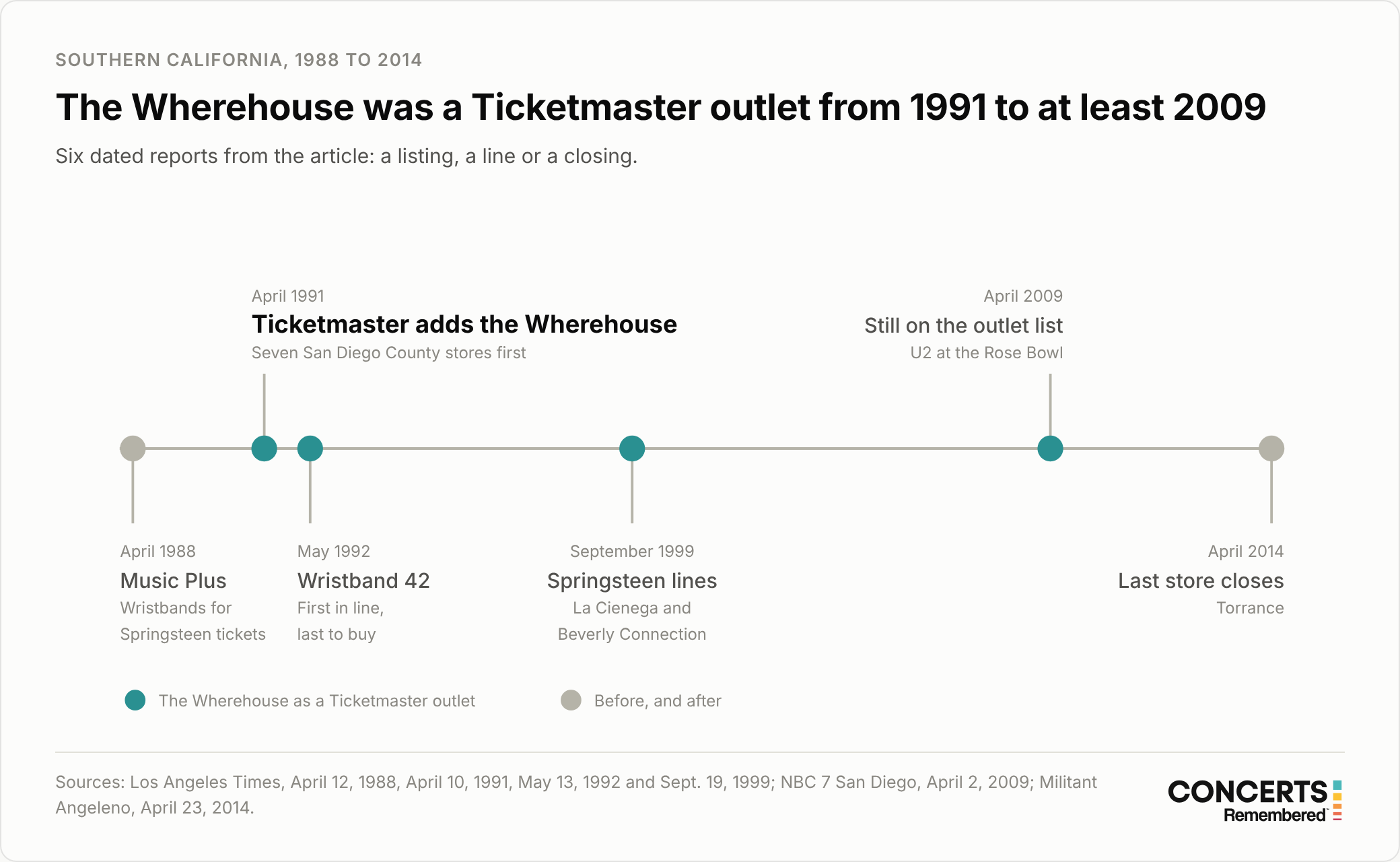
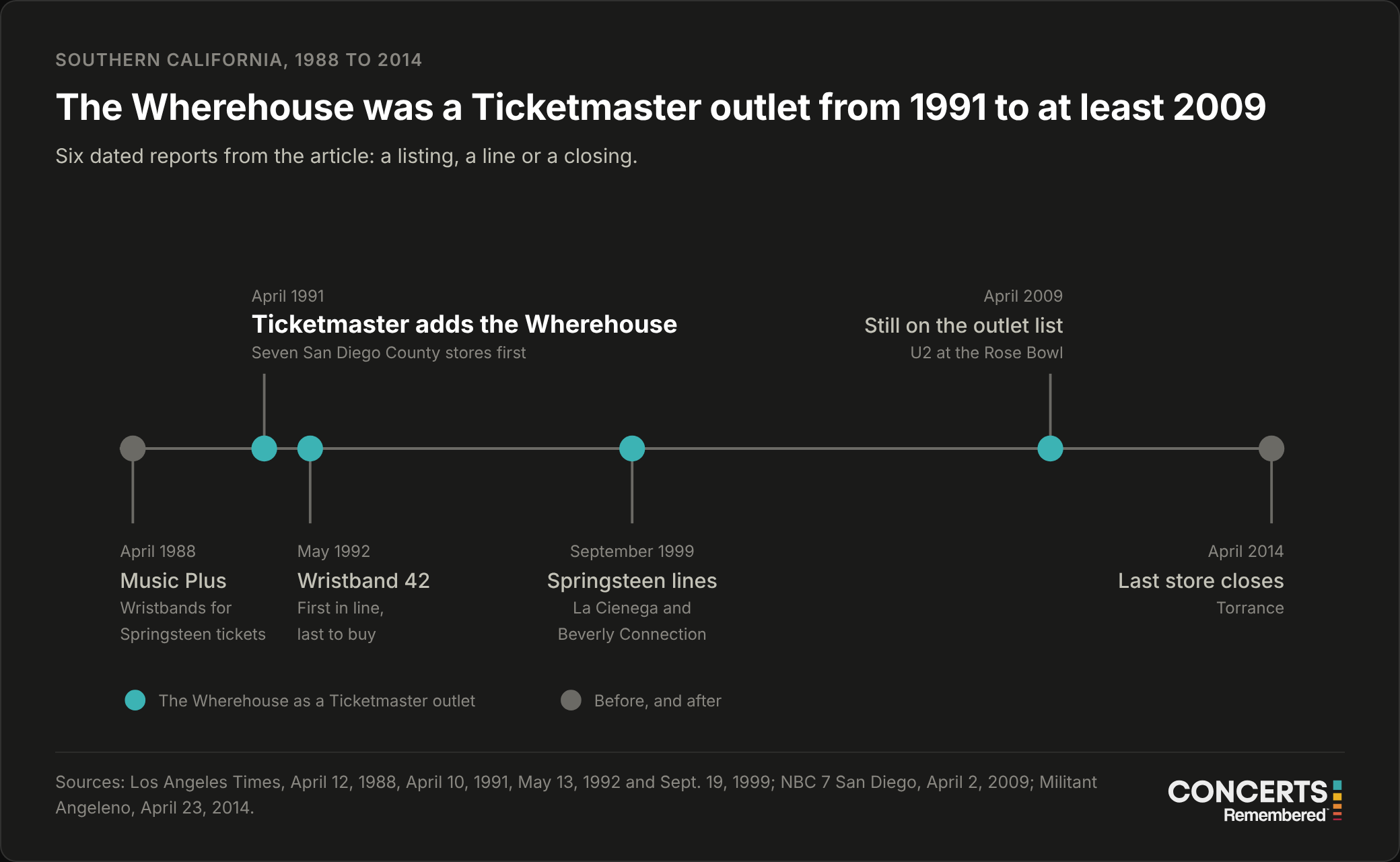 Six dated reports, from the 1988 Music Plus wristbands to the last store's closing in 2014.
Wristbands, 1991 and 1992
Two months later, the Times listed a Guns N' Roses and Skid Row show at the Pacific Amphitheatre in Costa Mesa. Tickets went on sale on a Sunday at 9 a.m. "at the box office and at Ticketmaster locations in Tower, Music Plus and Wherehouse stores only." The listing added: "Priority numbered wristbands will be issued at random at 8 a.m."
Katz's sale came the following May. That July, for Street Scene, the Times listed sales on a Saturday at 10 a.m. at Ticketmaster outlets at Tower Records, Music Plus and "non-mall Wherehouse stores." Priority-numbered wristbands went out at 8 a.m. at the Sports Arena and at 9 a.m. elsewhere.
Melissa Mora Hidalgo wrote in L.A. TACO in 2018 that in the early 1990s she and her high school friends would wait in line at 3 a.m. at a Wherehouse in East Whittier for tickets that went on sale at 10 a.m. It was, she wrote, "the only place in East Whittier, as far as we knew, that had a Ticketmaster that gave away the precious wristbands that determined whether or not you'd score tickets to The Cure, Depeche Mode, or Morrissey." She described the building as having housed "the Music Plus-turned-The Wherehouse record store."
One later memory puts a Wherehouse ticket line before 1991. On May 9, 2016, tony pierce posted on X that the last time he had waited that long for tickets "was when I slept out for AC/DC in front of Wherehouse Records in Venice in 1986." The Times's 1988 listings name Music Plus, and its April 1991 notes describe the Wherehouse joining Ticketmaster that month.
New owners and a kiosk deal, 1992 to 1998
In October 1992, Blockbuster Entertainment bought 236 Music Plus and Sound Warehouse stores from Shamrock Holdings, the Times reported. A spokesman said Blockbuster would likely rename them, though no final decision had been made. TIME put the price at $185 million, including assumed debt.
The Wherehouse's annual report for the year ended January 31, 1995 counted 347 stores in eleven states, about 78% of them in California. It said the company collected commissions on event tickets sold through Bay Area Seating Service (BASS) and Ticketmaster.
In June 1995, American Ticketing Systems of Irvine, which did business as Ameritix, agreed to put automatic ticket kiosks in 136 Wherehouse stores in Southern California by the end of the year, starting with 25, the Times reported. Buyers would choose seats from a map and pay by credit card, "as if they were using an automated teller machine."
On October 2, 1995, the Securities and Exchange Commission announced a complaint against American Ticketing Systems and four other defendants. According to the complaint, the defendants and others raised at least $3.2 million from more than 225 investors between February 1994 and May 1995 through the fraudulent sale of unregistered partnership interests. The defendants consented to a permanent injunction without admitting or denying the allegations.
In August 1998, Viacom agreed to sell its Blockbuster Music chain to the Wherehouse for $115 million in cash, the Times reported. Blockbuster Music had 52 stores in the Southland and the Wherehouse about 70, and the Wherehouse said it would convert the Blockbuster sites between January and mid-1999. The Wherehouse's next annual report gave a base price of $114.5 million, subject to adjustment, for 378 Blockbuster Music stores in 33 states, and a closing date of October 26, 1998. By January 31, 1999, the chain had 579 stores. That May it reported that it was completing sign changes to rename the Blockbuster Music stores Wherehouse or Wherehouse Music.
Beverly Connection, September 1999
On September 17, 1999, Geoff Boucher's guide in the Times to getting tickets for Bruce Springsteen and the E Street Band advised walk-up buyers against camping out. "The days of lining up at midnight have given way to the wristband era, where randomly numbered bracelets determine the purchase order," he wrote. It was one wristband per person, children under 12 were not eligible, and the ticket had to be bought at the site where the wristband was given out. Ticketmaster outlets included Tower Records, Robinsons May, Wherehouse Music, Ritmo Latino and Tu Musica.
Two days later, Boucher reported from the sidewalks. Taylor Brown, 14, confronted by a throng of thirty- and fortysomethings lined up outside Wherehouse Music on La Cienega Boulevard, asked, "What's with all the old people?"
Michael Loizzo, 43, huddled with his wife and 20-month-old son outside Wherehouse Music at the Beverly Connection plaza. "Bruce is back with the E Street Band. What more can you say? I don't know what could be bigger than this, maybe a Beatles reunion," he said.
Debra Bard, 46, showed up that Saturday at about 7:30 a.m. and was first in line at the Wherehouse at the Beverly Connection. "You would sit up all night, it was a party scene and you'd swap stories," she said. "This time we got to do that for an hour and a half, and that's fine with me. I don't miss the overnight stuff. I like my bathroom."
| Reported in the Times | Act or event | Where buyers were sent | Rule |
|---|---|---|---|
| April 12, 1988 | Bruce Springsteen | Music Plus/Ticketmaster stores | Priority wristbands from 4 p.m. on the day radio stations were told |
| Sept. 9, 1988 | George Michael, Irvine Meadows | Ticketmaster locations in Music Plus stores | Wristbands 8 a.m., sale 9 a.m. Sunday |
| June 14, 1991 | Guns N' Roses and Skid Row, Pacific Amphitheatre | Box office; Tower, Music Plus and Wherehouse stores only | Numbered wristbands at random, 8 a.m.; sale 9 a.m. Sunday |
| May 13, 1992 | The May 2 sale David Katz lined up for | Wherehouse, College and El Cajon Boulevard | First buyer was wristband 42; sale moved from 10 a.m. to 11:08 |
| July 8, 1992 | Street Scene | Tower Records, Music Plus, non-mall Wherehouse stores | Wristbands 8 a.m. at the Sports Arena, 9 a.m. elsewhere; sale 10 a.m. Saturday |
| Sept. 17, 1999 | Bruce Springsteen and the E Street Band | Tower Records, Robinsons May, Wherehouse Music, Ritmo Latino, Tu Musica | Random numbered wristbands, one per person; ticket bought where the wristband was issued |
Recollections, 2022 to 2025
A poster on X recalled the two-step line in July 2022: "Remember standing in line to get a ticket for what place in line you would be, then go back line up by priority and purchase them." In November 2022, Robert Colosia posted about "standing over night in line at Grossmont Mall Wherehouse Records Ticketmaster" for U2 tickets. Another poster wrote in March 2023 that she had camped out for Morrissey tickets once, "and nobody else ever came to wait in line."
Jeff Siwanowicz, who wrote in October 2025 that he had worked at a Wherehouse, recalled "the day U2 tickets went on sale and our Ticketmaster machine broke just before we opened."
The last outlets, 2001 to 2014
Ticketmaster's annual report for 2001 named Wherehouse Music among the music stores serving as its outlets, with Tower Records and Trans World Entertainment. By Ticketmaster's figures for that year, 34.1% of its ticket sales went through retail outlets, 33.8% through call centers and 32.1% through its websites.
On January 31, 2002, the Wherehouse had 407 stores in 23 states. Its annual report for that year still listed commissions on event tickets sold "under an affiliation with Ticketmaster."
On October 2, 2003, Trans World Entertainment bought substantially all of the chain's assets. The Wherehouse was by then in Chapter 11 bankruptcy with 145 stores, according to Trans World's annual report. Trans World kept 111 of them, at a price of $35.2 million including acquisition costs, and the other 34 were liquidated. At the end of January 2004, Wherehouse Music was one of the names Trans World's freestanding stores operated under.
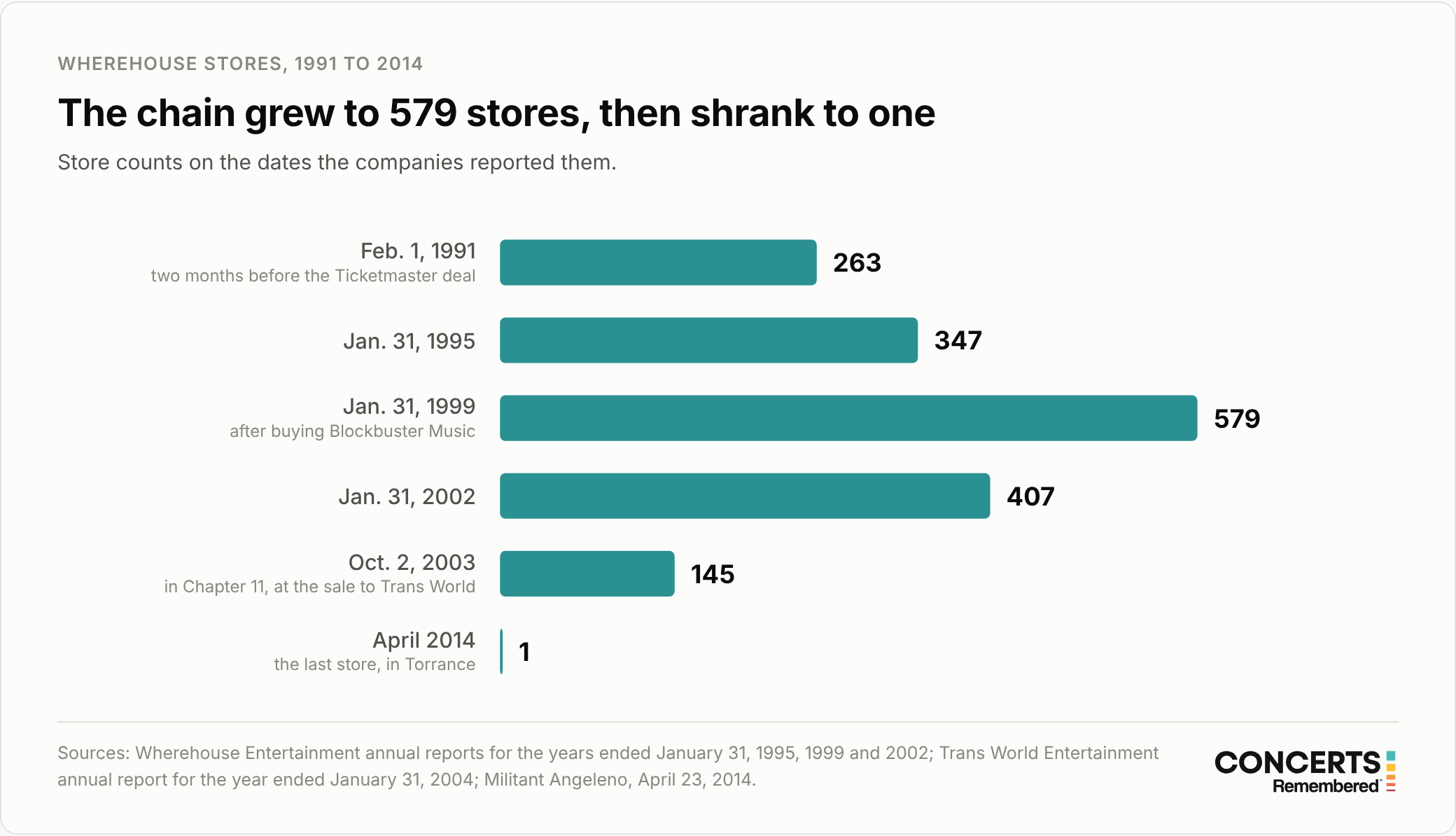
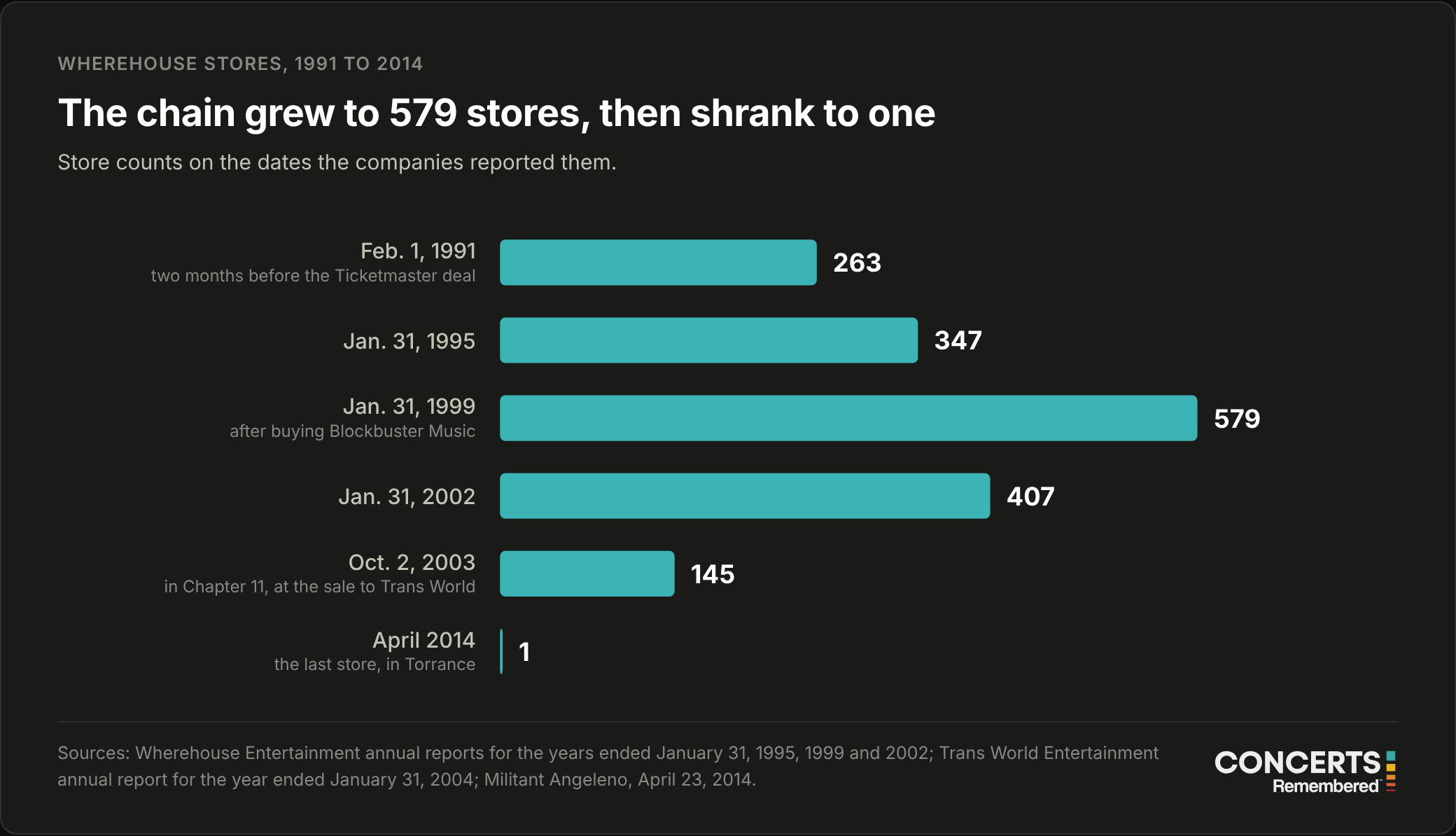 Store counts as the Wherehouse and Trans World reported them, with the last store from a 2014 report.
In April 2009, NBC 7 San Diego listed Wherehouse Music among the Ticketmaster retail outlets for a U2 show at the Rose Bowl that October.
On April 23, 2014, the Los Angeles blog Militant Angeleno reported that the last surviving Wherehouse, at 17542 Hawthorne Boulevard in Torrance, at the corner of Artesia Boulevard, was closing its doors for good that Friday, April 25.
Sources(32)Show allHide
- Los Angeles Times, "Rival to Ticketron : Ticketmaster Emerging as Force in L.A.", Jan. 31, 1985.
- Los Angeles Times, "Brokers Say They Got Their Springsteen Tickets", April 12, 1988.
- Los Angeles Times, "POP/ROCK - June 3, 1988", June 3, 1988.
- Los Angeles Times, "3rd George Michael Show Added at Irvine Meadows", Sept. 9, 1988.
- Los Angeles Times, "Depeche Mode Fans Become Unruly at Store", March 21, 1990.
- SPIN, "Pop a La Mode", July 1990.
- Los Angeles Times, "Sublime Bulgarian Choir to Return to Symphony Hall", April 10, 1991.
- Los Angeles Times, "Guns and Skid Row to Share Bill", June 14, 1991.
- Los Angeles Times, "Fan Finds There's No Cure for the Antics of Scalpers", May 13, 1992.
- Los Angeles Times, "Preview Taste of Street Scene Will Heat Up the Gaslamp", July 8, 1992.
- Los Angeles Times, "Blockbuster Buys 236 Retail Record Stores", Oct. 20, 1992.
- TIME, "A Blockbuster Deal", November 1992.
- Wherehouse Entertainment, Inc., Form 10-K for the fiscal year ended January 31, 1995.
- Los Angeles Times, "Automatic Ticket-Selling Kiosks to Be Put in Southland Wherehouse Stores", June 27, 1995.
- U.S. Securities and Exchange Commission, Litigation Release No. 14671, Oct. 2, 1995.
- Los Angeles Times, "Wherehouse to Buy Blockbuster Music", Aug. 12, 1998.
- Wherehouse Entertainment, Inc., Form 10-K for the fiscal year ended January 31, 1999.
- Los Angeles Times, "Setting a Course in Pursuit of Bruuuuce", Sept. 17, 1999.
- Los Angeles Times, "Boss Brigade Comes Out in Force for Concert Tickets", Sept. 19, 1999.
- Ticketmaster, Form 10-K for the fiscal year ended December 31, 2001.
- Wherehouse Entertainment, Inc., Form 10-K for the fiscal year ended January 31, 2002.
- Trans World Entertainment Corporation, Form 10-K for the fiscal year ended January 31, 2004.
- NBC 7 San Diego, "Presale Tickets for U2's ONE Cali Show", April 2, 2009.
- Militant Angeleno, "The Last Little Wherehouse In Torrance", April 23, 2014.
- tony pierce (@busblog), post on X, May 9, 2016.
- L.A. TACO, Melissa Mora Hidalgo, "Ode to the Other Whittier Boulevard, East of East L.A.", Feb. 14, 2018.
- OC Weekly, Jim "Poorman" Trenton, "Poorman's Radio Days: Recounting the Depeche Mode Riot of 1990", Sept. 17, 2019.
- Almost Predictable. Almost, "THE WHEREHOUSE" (interview with Mike LaJoie), March 18, 2020.
- FCSunsBills (@fcase18), post on X, July 18, 2022.
- Robert Colosia (@agenterob), post on X, Nov. 23, 2022.
- claudia (@desert_claudia), post on X, March 14, 2023.
- Jeff Siwanowicz (@JSiwanowicz), post on X, Oct. 25, 2025.