

Somewhere in the Stade de France stands last week, the President of France was holding a glowing lightstick. Emmanuel and Brigitte Macron turned up for BTS's two-night Paris finale, 184,000 fans across July 17 and 18, the biggest crowds the band has ever drawn. Fans near the barricade filmed Jungkook standing still for three minutes during "We Are Bulletproof: The Eternal," meeting eyes with the people crying in the pit until he cried too. The post-service reunion tour didn't just take over the 2026 calendar. It turned a head of state into ARMY.
The Long Take
Why resale caps won't lower the ticket price you pay
Governor Maura Healey stood in the Massachusetts State House on July 16 and unveiled a ticket bill named after a Noah Kahan album. Kahan endorsed it by video. The Great Divide Act caps resale at 110 percent of face value. Two days earlier, the DC Council had voted unanimously to cap resale markups at 10 percent.
Everyone cheered. I want to ruin it a little.
You were never getting robbed at resale.
You were getting robbed at checkout.
Here is the number nobody put on a slide this week. An Automatiq analysis of 186,113 transactions found that 62 percent of 2024 resales sold for less than the original box-office cost.
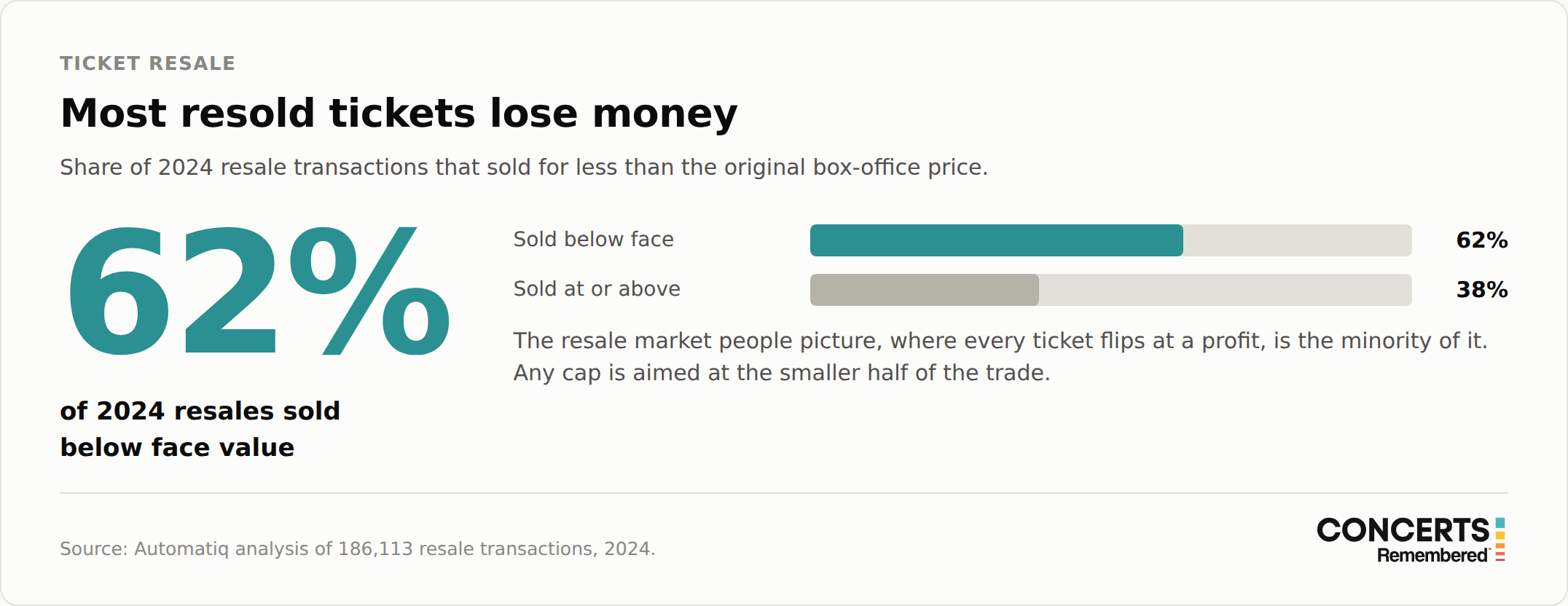 The scalper monster that the caps exist to slay is, most of the time, a person eating a loss on a ticket they can't use.
The money is in the fee stack: service fee, facility fee, processing fee, the ones that fluctuate per venue and per artist deal and stay hidden until the final screen.
And those fees are not Ticketmaster reaching into your pocket alone. A chunk of them is negotiated into the artist's own payout. The fan blames the platform. The artist signed the deal.
The honest counter is that these caps are a real, overdue win, and I mostly agree. A 10 percent resale cap is a sharper tool than any fee-transparency law. But Ontario passed a resale cap in April, and by early July had issued zero fines and still couldn't define a ticket's original price. A cap is only as good as the enforcement nobody funds, and even a perfect one never touches the checkout page.
So cap the resale market. Cheer the 10 percent. Then check the fee line on your next order.
The number that never had a law.
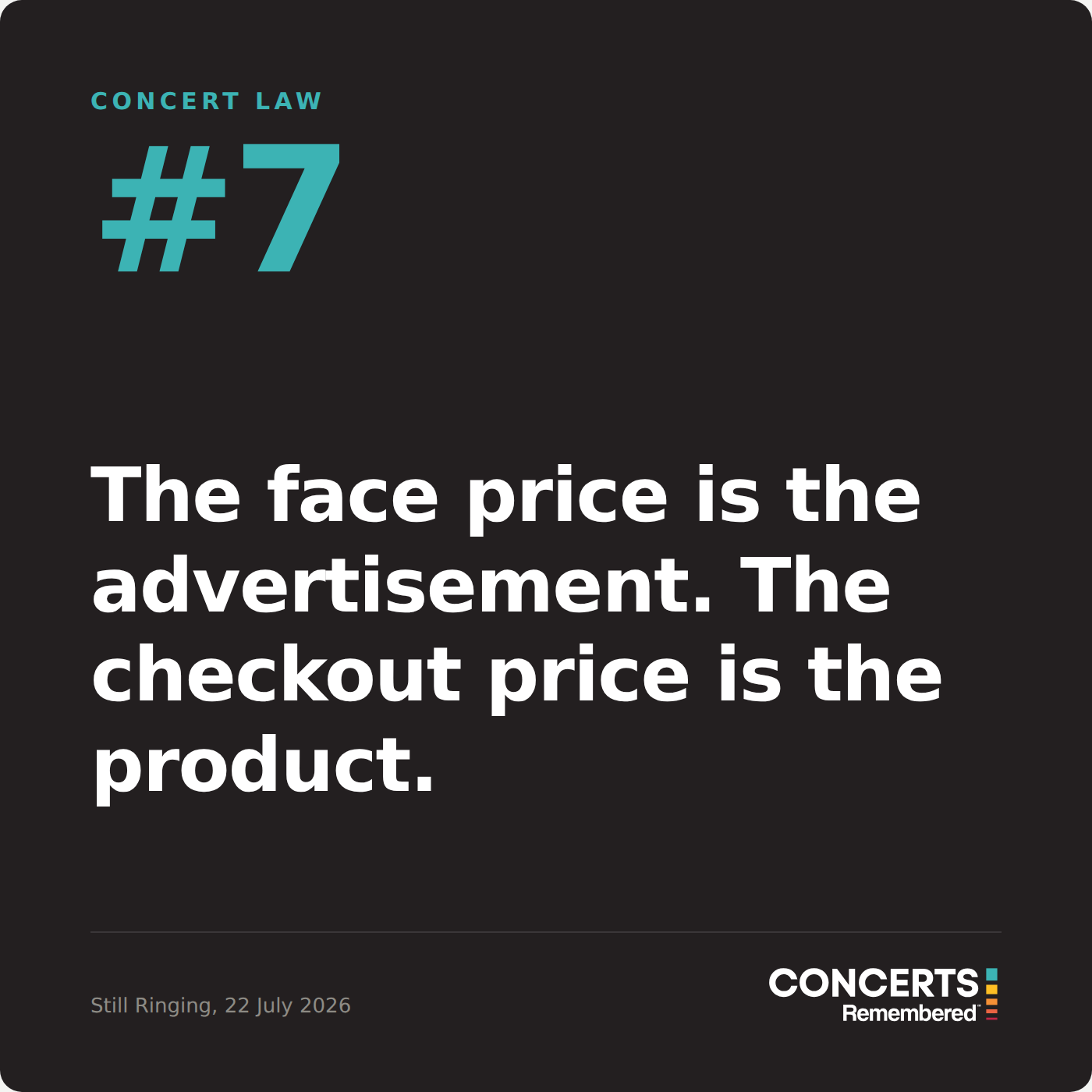
Concert Law #7: The face price is the advertisement. The checkout price is the product.
The face price is the advertisement. The checkout price is the product.
This Week in Shows
An entire UK festival series cancels at once. Heritage Live scrapped its whole 2026 summer, wiping out Eric Clapton, Lionel Richie, Janet Jackson and Christina Aguilera dates weeks before gates, after soft sales and a last-minute investor collapse. Thousands of ticket-holders are now chasing refunds across six platforms. It is the clearest single sign this year that the top of the market sells out while the middle quietly buckles.
Smoke checks are the new weather checks. Wildfire haze cancelled Mellencamp at Pine Knob outright, pushed the Black Keys indoors in Chicago, and postponed Creed and Alanis Morissette, while other festivals played on under the same sky. There is no shared air-quality threshold, so identical smoke means a cancellation at one venue and gates-open at the next. Learn the refund math before you drive: cancelled shows refund automatically, postponed ones do not.
Ella Langley loses a dress and wins a stadium. Two songs into her opening set for Morgan Wallen in a rain-soaked Baltimore, Langley's dress came unzipped, and she saved it with a custom Ravens jersey and finished the show. Ex-Ravens coach Rex Ryan promptly declared himself "officially an Ella Fella." Her "Choosing Texas" is in its 14th week at No. 1, and she just handed the internet its favorite clip of the week.
Bob Dylan, 85, picks the small room on purpose. Dylan will close his UK run with five nights at Royal Festival Hall, a 2,700-seat concert hall, after arena dates in Birmingham and Sheffield. It is his first London stand since 2024. An artist who could fill arenas choosing a seated room makes every ticket precious and brutal to get. On-sale is today.
The Venue Report
Some weeks the venue news is all obituaries. This week Pittsburgh got a resurrection. Club Cafe, the 25-year South Side listening room that went dark in 2024, is coming back with a grand reopening July 31 through August 3. The people bringing it back are the co-founders of Keystone Artist Connect, and they are reviving the room specifically to protect its role for the city's songwriters, the kind of low-capacity stage where a writer plays to a quiet room instead of a talking one. It is the counterweight to a summer of closure notices from Ghost Light to Music Hall of Williamsburg to Bottom of the Hill. Regional story, universal feeling. Everybody has one room they assumed was gone for good.
The size of the global ticket resale market in 2024. That is the economy the new caps are trying to fence in.
Then
Thirty years ago this month, Metallica headlined Lollapalooza, and the people who built the festival treated it like a betrayal. Detractors branded the 1996 run "Metal Fest '96," and co-founder Perry Farrell walked away from the festival he created rather than watch it become something else. Every modern lineup-reveal meltdown, every "this isn't what this festival is anymore," is a rerun of that summer. The argument was never really about Metallica. It was about who a festival belongs to once it gets big enough to stop being yours.
Fan Debate
Here is a fun one to argue about at the merch line. Rush are reportedly in talks for a Las Vegas Sphere residency in 2027, nothing confirmed by band or venue, and Billy Corgan weighed in on the whole Sphere question the same week. One camp says a catalog like Rush's belongs in real rooms across real cities, a tour you can actually get to. The other says the Sphere is the one venue on earth built for exactly the kind of sci-fi spectacle Rush trades in, and a residency you travel to once beats a routing you skip. So be honest with yourself: if your favorite legacy act could do one Sphere residency or one real tour, which do you actually want, and would you really make the trip?
B-Sides
- Lily Allen right-sizes a tour in real time. Allen quietly moved five arena dates to theaters and cancelled Montreal outright before the "West End Girl" run even launched. Read it as market data, not a knock: the same week Heritage Live collapsed, the middle of the touring market kept contracting.
- Matt Damon and Anne Hathaway are just concert heads with better day jobs. A new interview has both of them cataloguing the Bowie and Radiohead shows that shaped them. Jake's aside: everybody keeps a mental setlist archive, and writing yours down is the whole point.
- Reading Festival wants your Thursday. Reading applied to become a four-day event, putting main-stage music on Thursday nights from 2027. The three-day festival is quietly going extinct.
- The rock community shows up for one of its own. Green Day, Garbage, Pearl Jam and thousands of fans gave $300,000 to L7 bassist Jennifer Finch within days of her cancer diagnosis going public. The scene that saw L7 in sweaty rooms 30 years ago still acts like a scene.
- Now the question is what your venue knows about you. Madison Square Garden sued WIRED over a report describing a leaked 39,539-entry guest database with risk scores and "do not host" flags. Set the defamation fight aside: a database that big existed and later leaked, and biometric entry is spreading to a venue near you.
The room with the low ceiling and the sticky floor, the one everybody swore had closed years ago, still had your name on the list the night you finally drove back to check.
The Bit
Some feuds age like milk, and System Of A Down spent two nights making sure. At Tottenham Hotspur Stadium, Serj Tankian named a tapeworm "Oasis" and led 60,000 people in a stadium chant about it, then Daron Malakian told the crowd "if you guys lose, I blame Oasis" before England's World Cup semi. England lost. Liam Gallagher, of all people, took the high road. Nobody plans for grace from a Gallagher.
Every closure notice this summer had a resurrection hiding a few weeks behind it, if you waited for the correction.
Still Ringing lands free in your inbox every Wednesday. Subscribe and tell Jake where he's wrong.
See you at the show. Jake
The Newsletter
Still Ringing
Weekly issues on Wednesdays, deep cuts on Thursdays. The stuff worth knowing before you buy tickets — free, straight to your inbox.